Sales and operations planning (S&OP) is the monthly planning process that aligns demand plans, supply planning, and financial planning into one operating plan. It helps the sales team, operations team, finance, and executive management stay on the same page, balance supply with expected demand, improve customer service, reduce inventory costs, and support overall business performance. |
A sales team closes deals based on future sales expectations. Operations builds around production capacity, inventory management, and supply constraints.
Finance works toward financial targets, working capital goals, and overall corporate strategy. When those teams work from different numbers, the entire organization pays for it.
That is exactly why sales and operations planning matters.
Sales and operations planning, commonly called S&OP, is the critical cross functional process that brings sales and operations together around one consensus demand plan. It is part planning process, part decision framework, and part operating rhythm.
Done well, it helps companies balance supply and demand plans, respond faster to market trends, reduce supply chain issues, and make better trade offs before problems hit revenue or customer service.
This guide breaks down what the S&OP process looks like, how the planning cycle works, what key performance indicators matter, how the pre-S&OP meeting should run, what sales and operations planning software should support, and how CRM data improves the demand side of the process.
What is sales and operations planning?
Sales and operations planning is the monthly business process that connects expected demand with supply planning, financial planning, and execution decisions.
In simple terms, it helps the entire company agree on what it expects to sell, what it can deliver, what it can afford, and what trade-offs leadership needs to make.
A lot of people treat S&OP like a supply chain meeting. That is too narrow. It is a business management process. It touches sales and operations, marketing teams, finance, executive teams, and in many companies, product and customer success too.
The goal is not just to produce demand plans or supply and demand plans in isolation. The goal is to create one operating plan that the entire organization can trust.
This is where the real value shows up. Instead of reacting late to supply chain disruptions, missed forecast accuracy, or capacity gaps, the business spots problems earlier. That improves customer service, protects working capital, and makes the planning sales cycle more stable.
A good operations planning process usually runs every month and looks ahead across the next few quarters. It reviews current performance, studies market trends, updates demand forecasts, checks production capacity or service capacity, and then brings leadership into one executive meeting to approve a single path forward.
Insightful read: Sales operations: Definition, strategies, tools, and metrics.
A brief history of S&OP
The roots of S&OP go back to earlier forms of aggregate planning and enterprise resource planning, when businesses needed better ways to connect sales plans with operations process decisions. Over time, the method matured from a manufacturing-heavy planning model into a broader business process used across industries.
Today, modern sales and operations planning is more than an ops spreadsheet exercise. It is a structured planning cycle used to align business processes, connect strategic plans with day-to-day decisions, and guide better sales execution across the entire company.
S&OP vs. IBP vs. S&OE: What is the difference?
These terms are related, but they are not the same.
S&OP sits in the middle. It is more strategic than sales and operations execution, but more operational than full integrated business planning.
If S&OE handles this week’s disruptions, and IBP shapes long-range corporate strategy, S&OP is the monthly bridge that turns strategic plans into realistic operating decisions.
Why S&OP matters for the business
Most companies do not struggle because they lack data. They struggle because the data lives in multiple systems, moves at different speeds, and leads to different assumptions.
Sales sees future sales one way. Operations sees manufacturing capacity or service delivery in one way. Finance sees working capital and financial success through a different lens. When those teams are not aligned, the result is familiar: excess inventory, missed orders, rushed production, broken financial planning, poor customer experience, and leadership teams constantly stepping into avoidable conflicts.
That is why sales and operations planning matters. It forces cross-functional collaboration around one set of numbers and one decision framework.
Here is what a mature S&OP planning process improves:
- Better forecast accuracy and more realistic demand forecasts
- Tighter control over inventory management and inventory costs
- Better visibility into supply constraints and production capacity
- Stronger connection between sales plan and corporate strategy
- Faster response to market trends and supply chain disruptions
- Better working capital discipline
- Clearer decisions for executive teams
|
The biggest benefit, though, is simpler: S&OP helps the business stop arguing about whose spreadsheet is right and start making better business decisions.
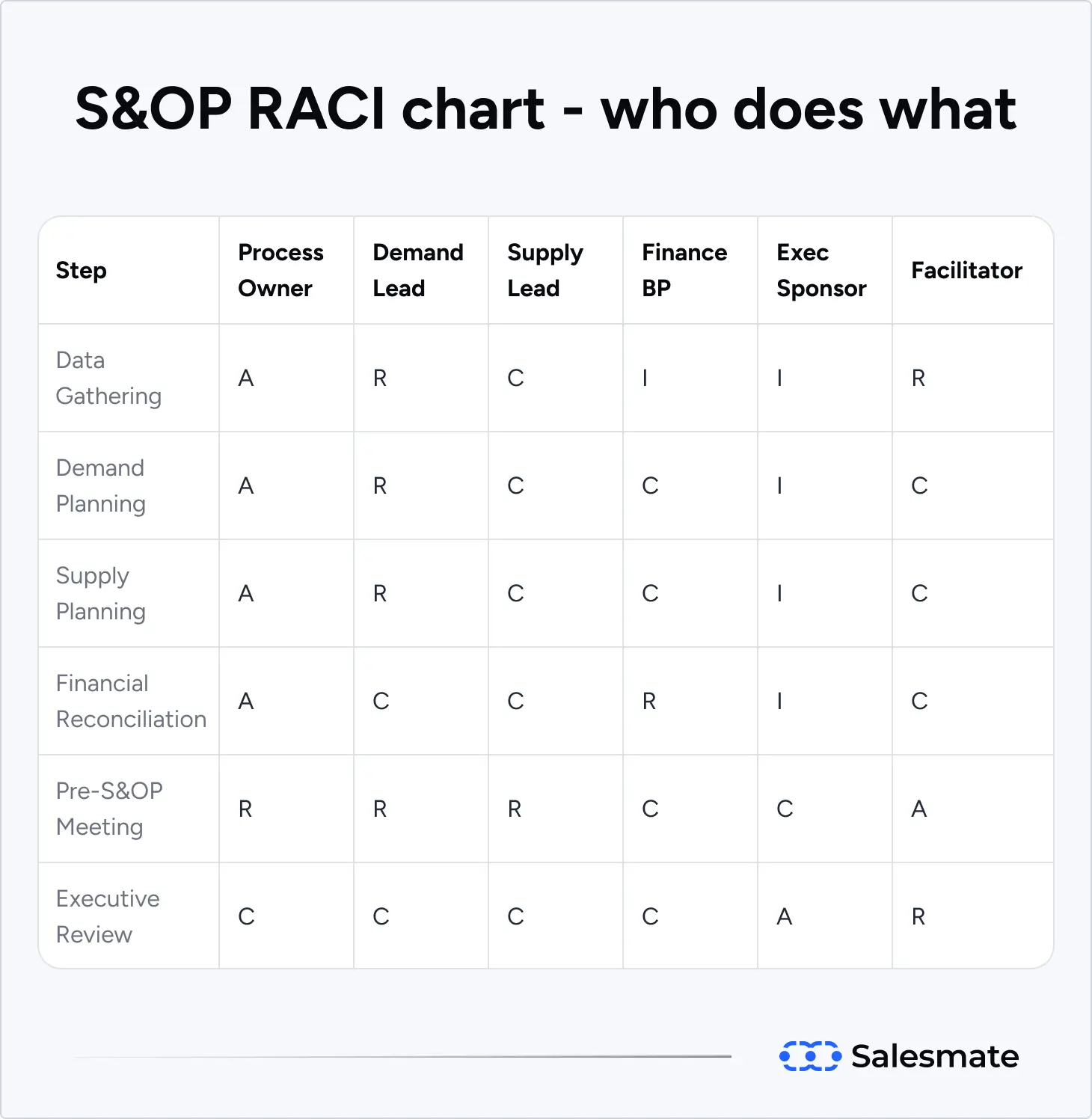
What are the 6 steps of the S&OP process?
A strong S&OP process is not one big meeting.
It is a structured monthly planning cycle. Each step should produce a clear output so the next step becomes easier and more useful.
Step 1: Data gathering and product portfolio review
Every good S&OP cycle starts with data gathering.
This is where teams collect all the data needed to review the prior period and prepare the next demand and supply plans. That includes sales forecast performance, actual demand, customer orders, backlog, inventory management data, capacity utilization, service levels, working capital, supply chain issues, and major market trends.
The team should also review the product portfolio. New launches, product phase-outs, seasonal shifts, and low-performing products all affect expected demand and supply planning. If this step is weak, the entire S&OP process becomes weak because the business starts debating bad inputs instead of making decisions.
The goal of this step is simple: give everyone a shared fact base before the planning discussions begin.
Step 2: Demand planning and forecasting
This is the heart of S&OP demand planning.
The demand planner, sales team, marketing teams, and finance usually work together here to build an updated view of future sales. A good consensus demand plan should combine historical demand, active sales pipeline, campaign plans, market trends, account knowledge, seasonality, and known business risks.
This is also where CRM becomes highly valuable. CRM data gives the business visibility into the deal stage, opportunity value, win probability, close timing, and changes in buying behavior. That helps demand forecasting planning move beyond guesswork and build demand plans based on actual sales signals.
If the business sells through multiple channels, demand forecasts should reflect that. If large deals, renewals, or regional shifts are likely to distort demand, that should be visible here too. A strong sales forecast does not just predict volume. It gives operations planning a better view of what is actually coming.
The output of this step is a consensus demand plan that the business can test against operational reality.
Improve your sales forecasting accuracy
Build reliable forecasts using real-time pipeline data, deal stages, and win probability instead of static spreadsheets.
Step 3: Supply planning and capacity review
Once the demand plan is clear, the supply planner and operations team evaluate whether the business can support it.
In manufacturing, that may mean checking production capacity, labor availability, material risk, supplier constraints, and inventory levels. In services, it may mean billable capacity, skill availability, and staffing utilization. In software, it may mean onboarding capacity, implementation bandwidth, or support readiness.
This is where many teams discover the gap between ambition and reality.
If the demand side is asking for aggressive growth but the supply side sees manufacturing capacity limits, supplier delays, or overloaded teams, the company needs to decide what gives. That is why supply planning is not just about saying yes or no. It is about highlighting options, risks, and trade-offs.
The output here is a supply and demand plans comparison that shows whether the business can meet demand as planned or whether changes are needed.
Also read: How does AI demand forecasting empower smart supply chains?.
Step 4: Financial planning and plan reconciliation
This step is often skipped, and that is a mistake.
A business can create great demand plans and reasonable supply planning assumptions and still end up with a plan that misses margin targets, cash goals, or financial success expectations. That is why financial planning and plan reconciliation matter.
Finance translates the proposed operating plan into revenue, margin, operating costs, inventory impact, and working capital effects. Then leadership compares that picture against financial targets and the broader corporate strategy.
If the operational plan does not support the company’s financial direction, the business needs to make decisions. That may mean reducing inventory exposure, adjusting sales priorities, pacing marketing spend, shifting supply commitments, or changing timing assumptions.
This is the moment where sales and operations planning becomes more than an operations planning exercise. It becomes a business decision framework.
Insightful: How to Use CRM for Accurate Revenue Forecasting.
Step 5: Pre-S&OP alignment meeting
Before the executive teams meet, the functional leaders should hold a pre S&OP meeting.
This meeting is where sales, operations, finance, and other leaders review open gaps, challenge assumptions, and narrow down decision options. The point is not to rehash the whole planning process. The point is to prepare a clean, decision-ready view for senior management.
A good pre-S&OP meeting covers:
- Demand gaps
- Supply constraints
- Financial risks
- Key trade-offs
- Scenarios that need executive review
If this step is skipped, the executive meeting turns into a messy working session. That slows decisions and weakens accountability.
Step 6: Executive S&OP review and approval
The executive management meeting is where final decisions are made.
Senior management reviews the demand plan, supply plan, financial impact, risk areas, and scenario options. They approve the operating plan, request changes, or escalate trade-offs that affect the business more broadly.
This meeting should not become a detail-heavy operations review. It should focus on the decisions only executive teams can make: investment priorities, trade-offs across functions, major capacity commitments, and actions needed to keep the company on track.
The output of this step is a single approved plan and a clear set of owners for what happens next.
The S&OP meeting: Agenda, cadence, and how to run it
A lot of teams talk about S&OP, but very few know how to run the executive meeting well.
The answer is not to create longer meetings. The answer is to create cleaner inputs and a tighter agenda.
A monthly cadence works best for most businesses. That gives the team enough time to see meaningful changes, update demand plans, assess supply planning risks, and make decisions before issues grow larger. Weekly reviews can support sales and operations execution, but the formal S&OP cycle should usually stay monthly.
A practical monthly S&OP meeting agenda
| Agenda item | Time | Presenter | Purpose |
|---|
| Opening and objectives | 5 min | Process owner | Confirm decisions needed |
| KPI and prior month review | 10 min | Finance or operations | Review forecast accuracy, service, inventory, working capital |
| Demand plan summary | 15 min | Sales or demand planner | Review future sales, demand shifts, market trends |
| Supply planning summary | 15 min | Operations or supply planner | Review capacity, supply constraints, inventory exposure |
| Financial review | 10 min | Finance leader | Review plan vs financial targets |
| Gap analysis and scenarios | 15 min | Process owner | Show trade offs and options |
| Executive decisions | 15 min | Senior management | Approve direction and actions |
| Action items and owners | 5 min | Process owner | Confirm next steps |
This meeting should stay focused on decisions, not deep analysis. All the data analysis should happen before the room fills with executives.
What a good S&OP deck looks like
A strong S&OP deck should help leadership move through the planning process quickly. It should usually include:
- Agenda and decisions required
- Prior month KPI snapshot
- Demand plan summary
- Supply planning summary
- Financial planning summary
- Risk and issue view
- Scenario options
- Trade offs and recommendation
- Final decisions and owners
If the deck is overloaded with raw detail, the meeting slows down. If it is too high-level, executive teams cannot make confident decisions. The sweet spot is summarized first, backup detail in the appendix. |
12 S&OP KPIs that actually matter
Teams often track activity instead of quality. They measure whether the meeting happened, whether people attended, or whether the file was shared. Those are not useless, but they are not enough.
A strong set of key performance indicators should tell you whether your sales and operations planning process is improving decision quality and business performance.
| KPI | What it measures | Simple formula |
|---|
| Forecast accuracy | How close forecasts are to actuals | (Actual - Forecast) error over time |
| Forecast bias | Whether forecasts skew high or low | Average forecast error direction |
| Plan adherence | Whether teams executed against plan | Actual output ÷ planned output |
| Inventory turns | Inventory efficiency | Cost of goods sold ÷ average inventory |
| Customer service level | Order fulfillment performance | Orders fulfilled on time ÷ total orders |
| OTIF delivery | On-time, in-full performance | OTIF deliveries ÷ total deliveries |
| Capacity utilization | Use of available capacity | Actual output ÷ available capacity |
| Revenue vs plan | Sales execution vs plan | Actual revenue ÷ planned revenue |
| Working capital | Cash tied up in operations | Current assets - current liabilities view |
| Demand volatility | Stability of expected demand | Change rate across demand forecasts |
| Schedule adherence | Production or service reliability | Actual schedule met ÷ planned schedule |
| Meeting decision closure | Action follow-through | Closed action items ÷ total actions |
These KPIs work best when grouped into three categories:
Process health metrics
These show whether the S&OP cycle is running properly. Meeting cadence, action closure, and schedule adherence sit here.
Plan quality metrics
These show whether demand and supply plans are realistic. Forecast accuracy, forecast bias, demand volatility, and plan adherence matter most here.
Business impact metrics
These show whether the Business sales process improves results. Inventory costs, working capital, customer service, capacity utilization, and revenue growth sit here.
If a company has poor forecast accuracy and rising inventory costs, the S&OP process is not doing its job, no matter how polished the deck looks.
S&OP maturity model: Where does your process stand?
Not every company needs best-in-class S&OP on day one. But every company should know where it stands.
A simple maturity model helps leadership see whether the current operations planning process is reactive, stable, or genuinely strategic.
| Maturity stage | Process quality | People alignment | Technology support | Metrics discipline |
|---|
| Ad hoc | Inconsistent, informal | Siloed teams | Spreadsheet-heavy | Few KPIs |
| Basic | Monthly reviews exist | Some cross functional collaboration | Multiple systems, partial visibility | Basic reporting |
| Standard | Defined S&OP cycle | Roles are clear | Better integration | Regular KPI tracking |
| Advanced | Scenario-based planning | Strong executive support | Connected systems | Metrics drive decisions |
| Best-in-class | Proactive, disciplined | Entire company aligned | Integrated planning stack | Continuous improvement culture |
If your business still debates basic numbers in every meeting, you are probably in the ad hoc or basic stage. If teams show up with one agreed view of expected demand, financial targets, and capacity choices, you are moving into the advanced stage.
The goal is not maturity for its own sake. The goal is a planning cycle that the business can trust.
How CRM data powers the demand side of S&OP
This is the piece most S&OP articles miss.
Demand planning is only as good as the signals behind it. If the sales forecast lives in disconnected spreadsheets, or if deal movement is invisible until month-end, operations planning will always lag behind reality.
CRM changes that.
A strong CRM gives the business visibility into future sales, sales pipeline stage, close timing, opportunity size, conversion patterns, account movement, and changes in buyer behavior. That gives demand planners a better starting point for demand forecasts and lets operations planning respond earlier.
In practical terms, CRM supports S&OP by helping teams:
- See weighted pipeline, not just booked orders
- Spot demand changes earlier
- Validate sales plan assumptions
- Improve forecast accuracy
- Connect customer signals to planning decisions
For mid-market companies, this matters a lot. They often do not have giant planning teams or expensive enterprise resource planning stacks. They need business processes that connect sales and operations without adding heavy complexity. That is where CRM becomes a serious advantage, not just a sales tool.
Make your demand planning data-driven, not guesswork
Salesmate gives your team complete visibility into deal flow, conversion trends, and future revenue signals so your S&OP demand planning becomes faster, more accurate, and easier to trust.
What to look for in CRM software that supports S&OP
If CRM is going to support sales and operations planning, it should offer:
- Strong sales forecast visibility
- Deal-stage and close-date tracking
- Reporting across pipeline changes
- Easy custom dashboards
- Integration with finance or operations tools
- Reliable historical data for trend analysis
The right CRM will not replace dedicated S&OP software in every case. But it can dramatically strengthen the demand side of the planning process.
S&OP beyond manufacturing
A lot of people still think sales and operations planning only belongs in manufacturing. That view is outdated.
Any business that has to match demand with constrained capacity can benefit from S&OP. The mechanics change, but the logic stays the same.
| Business type | Demand side | Supply side | Capacity concern |
|---|
| Manufacturing | Orders, forecast, channel demand | Production and inventory | Manufacturing capacity |
| SaaS | Pipeline, renewals, growth targets | Implementation, onboarding, support | Team bandwidth |
| Professional services | Project demand, client pipeline | Consultant availability | Billable hours and skills |
| Distribution | Orders, replenishment demand | Warehouse and fulfillment | Throughput and inventory |
In SaaS, supply planning may not mean raw materials, but it still means balancing expected demand against implementation bandwidth, support coverage, and customer onboarding capacity. In services, it means aligning the sales plan with available talent. In distribution, it means balancing inventory management, supply chain risk, and service levels.
So yes, S&OP belongs far beyond manufacturing. The business just needs to define what demand, supply, and capacity mean in its own model.
Common S&OP mistakes and how to avoid them
Most S&OP failures are not caused by bad theory. They come from weak execution.
1. Treating S&OP like a supply chain-only exercise
This narrows the process too much. Sales, finance, and leadership need to be in it from the start.
2. Running the meeting before the work is done
If the pre S&OP meeting and data gathering are weak, the executive meeting becomes chaotic and low-value.
3. Ignoring financial planning
Demand and supply plans are not enough. The business needs plan reconciliation against margin, working capital, and financial targets.
4. Using stale or incomplete data
When the team works across multiple systems with bad data hygiene, trust in the process falls quickly.
5. Confusing optimism with a consensus demand plan
A consensus demand plan is not a wish list. It should reflect real signals, not just sales pressure.
6. Tracking too few KPIs
Without forecast accuracy, customer service, inventory costs, and capacity utilization, the business cannot tell whether the process is working.
7. Lacking leadership commitment
S&OP works best when senior management treats it as a real business process, not a recurring operations call.
The fix for most of these mistakes is discipline. Keep the process simple, consistent, data-backed, and clearly owned.
Sales and operations planning software: What to look for in 2026
Not every company needs the same kind of S&OP software.
Some large enterprises need advanced scenario planning, modeling, and enterprise resource planning integration. Others need simpler operations planning support with better visibility across sales and operations. The right choice depends on process maturity, company size, and complexity.
In broad terms, the market usually breaks into three categories:
1. Dedicated planning platforms
These are built for deep scenario modeling, connected planning, and large-scale planning environments. They are powerful, but often expensive and complex.
2. ERP-connected tools
These work well for businesses that already run heavily inside ERP systems and need tighter operations process control.
3. CRM-connected planning support
This is where tools like Salesmate fit more naturally. They help strengthen the demand side of S&OP by improving sales forecast visibility, customer insight, reporting, and cross-functional collaboration.
The honest answer is this: no single tool solves the entire S&OP planning process for every business. But the better your demand inputs, the better your operations planning decisions become. That is why CRM quality matters more than many teams realize.
A practical 90-day roadmap to launch S&OP
If your company does not have a formal S&OP cycle yet, do not overbuild it. Start with a clean 90-day rollout.
Days 1 to 30: Build the foundation
Define the owner, identify participants, agree on core Sales KPIs, audit all the data sources, and decide the monthly cadence.
Days 31 to 60: Run the first cycle
Create the first demand plan, supply review, financial review, and executive meeting. Expect some friction. That is normal.
Days 61 to 90: Improve the process
Tighten assumptions, improve meeting structure, clean sales reporting, and start measuring whether decisions are actually improving business performance.
A good first version beats a complicated version that never launches.
Bring clarity to your S&OP process with better sales data
Unified pipeline, forecasts, and customer signals lead to faster, more accurate S&OP decisions. Salesmate makes your sales data planning-ready.
Conclusion
Sales and operations planning is not just an operations planning s op exercise for manufacturers. It is the business process that helps companies align sales and operations, connect demand and supply plans, manage trade offs, and make better decisions before problems hit revenue, margins, or customer service.
When the process is strong, the business works from one view of expected demand, one view of capacity, and one set of financial targets. That makes the planning cycle more useful, the executive meeting more decisive, and the entire company more resilient.
For Salesmate, the angle is clear. The better your sales forecast, pipeline visibility, and customer data, the stronger your S&OP demand planning becomes. CRM will not replace every planning tool, but it can absolutely make the demand side of the process smarter, faster, and more trustworthy.









Key takeaways
Sales and operations planning (S&OP) is the monthly planning process that aligns demand plans, supply planning, and financial planning into one operating plan. It helps the sales team, operations team, finance, and executive management stay on the same page, balance supply with expected demand, improve customer service, reduce inventory costs, and support overall business performance.
A sales team closes deals based on future sales expectations. Operations builds around production capacity, inventory management, and supply constraints.
Finance works toward financial targets, working capital goals, and overall corporate strategy. When those teams work from different numbers, the entire organization pays for it.
That is exactly why sales and operations planning matters.
Sales and operations planning, commonly called S&OP, is the critical cross functional process that brings sales and operations together around one consensus demand plan. It is part planning process, part decision framework, and part operating rhythm.
Done well, it helps companies balance supply and demand plans, respond faster to market trends, reduce supply chain issues, and make better trade offs before problems hit revenue or customer service.
This guide breaks down what the S&OP process looks like, how the planning cycle works, what key performance indicators matter, how the pre-S&OP meeting should run, what sales and operations planning software should support, and how CRM data improves the demand side of the process.
What is sales and operations planning?
Sales and operations planning is the monthly business process that connects expected demand with supply planning, financial planning, and execution decisions.
In simple terms, it helps the entire company agree on what it expects to sell, what it can deliver, what it can afford, and what trade-offs leadership needs to make.
A lot of people treat S&OP like a supply chain meeting. That is too narrow. It is a business management process. It touches sales and operations, marketing teams, finance, executive teams, and in many companies, product and customer success too.
The goal is not just to produce demand plans or supply and demand plans in isolation. The goal is to create one operating plan that the entire organization can trust.
This is where the real value shows up. Instead of reacting late to supply chain disruptions, missed forecast accuracy, or capacity gaps, the business spots problems earlier. That improves customer service, protects working capital, and makes the planning sales cycle more stable.
A good operations planning process usually runs every month and looks ahead across the next few quarters. It reviews current performance, studies market trends, updates demand forecasts, checks production capacity or service capacity, and then brings leadership into one executive meeting to approve a single path forward.
A brief history of S&OP
The roots of S&OP go back to earlier forms of aggregate planning and enterprise resource planning, when businesses needed better ways to connect sales plans with operations process decisions. Over time, the method matured from a manufacturing-heavy planning model into a broader business process used across industries.
Today, modern sales and operations planning is more than an ops spreadsheet exercise. It is a structured planning cycle used to align business processes, connect strategic plans with day-to-day decisions, and guide better sales execution across the entire company.
S&OP vs. IBP vs. S&OE: What is the difference?
These terms are related, but they are not the same.
S&OP sits in the middle. It is more strategic than sales and operations execution, but more operational than full integrated business planning.
If S&OE handles this week’s disruptions, and IBP shapes long-range corporate strategy, S&OP is the monthly bridge that turns strategic plans into realistic operating decisions.
Why S&OP matters for the business
Most companies do not struggle because they lack data. They struggle because the data lives in multiple systems, moves at different speeds, and leads to different assumptions.
Sales sees future sales one way. Operations sees manufacturing capacity or service delivery in one way. Finance sees working capital and financial success through a different lens. When those teams are not aligned, the result is familiar: excess inventory, missed orders, rushed production, broken financial planning, poor customer experience, and leadership teams constantly stepping into avoidable conflicts.
That is why sales and operations planning matters. It forces cross-functional collaboration around one set of numbers and one decision framework.
Here is what a mature S&OP planning process improves:
The biggest benefit, though, is simpler: S&OP helps the business stop arguing about whose spreadsheet is right and start making better business decisions.
What are the 6 steps of the S&OP process?
A strong S&OP process is not one big meeting.
It is a structured monthly planning cycle. Each step should produce a clear output so the next step becomes easier and more useful.
Step 1: Data gathering and product portfolio review
Every good S&OP cycle starts with data gathering.
This is where teams collect all the data needed to review the prior period and prepare the next demand and supply plans. That includes sales forecast performance, actual demand, customer orders, backlog, inventory management data, capacity utilization, service levels, working capital, supply chain issues, and major market trends.
The team should also review the product portfolio. New launches, product phase-outs, seasonal shifts, and low-performing products all affect expected demand and supply planning. If this step is weak, the entire S&OP process becomes weak because the business starts debating bad inputs instead of making decisions.
The goal of this step is simple: give everyone a shared fact base before the planning discussions begin.
Step 2: Demand planning and forecasting
This is the heart of S&OP demand planning.
The demand planner, sales team, marketing teams, and finance usually work together here to build an updated view of future sales. A good consensus demand plan should combine historical demand, active sales pipeline, campaign plans, market trends, account knowledge, seasonality, and known business risks.
This is also where CRM becomes highly valuable. CRM data gives the business visibility into the deal stage, opportunity value, win probability, close timing, and changes in buying behavior. That helps demand forecasting planning move beyond guesswork and build demand plans based on actual sales signals.
If the business sells through multiple channels, demand forecasts should reflect that. If large deals, renewals, or regional shifts are likely to distort demand, that should be visible here too. A strong sales forecast does not just predict volume. It gives operations planning a better view of what is actually coming.
The output of this step is a consensus demand plan that the business can test against operational reality.
Improve your sales forecasting accuracy
Build reliable forecasts using real-time pipeline data, deal stages, and win probability instead of static spreadsheets.
Step 3: Supply planning and capacity review
Once the demand plan is clear, the supply planner and operations team evaluate whether the business can support it.
In manufacturing, that may mean checking production capacity, labor availability, material risk, supplier constraints, and inventory levels. In services, it may mean billable capacity, skill availability, and staffing utilization. In software, it may mean onboarding capacity, implementation bandwidth, or support readiness.
This is where many teams discover the gap between ambition and reality.
If the demand side is asking for aggressive growth but the supply side sees manufacturing capacity limits, supplier delays, or overloaded teams, the company needs to decide what gives. That is why supply planning is not just about saying yes or no. It is about highlighting options, risks, and trade-offs.
The output here is a supply and demand plans comparison that shows whether the business can meet demand as planned or whether changes are needed.
Step 4: Financial planning and plan reconciliation
This step is often skipped, and that is a mistake.
A business can create great demand plans and reasonable supply planning assumptions and still end up with a plan that misses margin targets, cash goals, or financial success expectations. That is why financial planning and plan reconciliation matter.
Finance translates the proposed operating plan into revenue, margin, operating costs, inventory impact, and working capital effects. Then leadership compares that picture against financial targets and the broader corporate strategy.
If the operational plan does not support the company’s financial direction, the business needs to make decisions. That may mean reducing inventory exposure, adjusting sales priorities, pacing marketing spend, shifting supply commitments, or changing timing assumptions.
This is the moment where sales and operations planning becomes more than an operations planning exercise. It becomes a business decision framework.
Step 5: Pre-S&OP alignment meeting
Before the executive teams meet, the functional leaders should hold a pre S&OP meeting.
This meeting is where sales, operations, finance, and other leaders review open gaps, challenge assumptions, and narrow down decision options. The point is not to rehash the whole planning process. The point is to prepare a clean, decision-ready view for senior management.
A good pre-S&OP meeting covers:
If this step is skipped, the executive meeting turns into a messy working session. That slows decisions and weakens accountability.
Step 6: Executive S&OP review and approval
The executive management meeting is where final decisions are made.
Senior management reviews the demand plan, supply plan, financial impact, risk areas, and scenario options. They approve the operating plan, request changes, or escalate trade-offs that affect the business more broadly.
This meeting should not become a detail-heavy operations review. It should focus on the decisions only executive teams can make: investment priorities, trade-offs across functions, major capacity commitments, and actions needed to keep the company on track.
The output of this step is a single approved plan and a clear set of owners for what happens next.
The S&OP meeting: Agenda, cadence, and how to run it
A lot of teams talk about S&OP, but very few know how to run the executive meeting well.
The answer is not to create longer meetings. The answer is to create cleaner inputs and a tighter agenda.
A monthly cadence works best for most businesses. That gives the team enough time to see meaningful changes, update demand plans, assess supply planning risks, and make decisions before issues grow larger. Weekly reviews can support sales and operations execution, but the formal S&OP cycle should usually stay monthly.
A practical monthly S&OP meeting agenda
This meeting should stay focused on decisions, not deep analysis. All the data analysis should happen before the room fills with executives.
What a good S&OP deck looks like
A strong S&OP deck should help leadership move through the planning process quickly. It should usually include:
If the deck is overloaded with raw detail, the meeting slows down. If it is too high-level, executive teams cannot make confident decisions. The sweet spot is summarized first, backup detail in the appendix.
12 S&OP KPIs that actually matter
Teams often track activity instead of quality. They measure whether the meeting happened, whether people attended, or whether the file was shared. Those are not useless, but they are not enough.
A strong set of key performance indicators should tell you whether your sales and operations planning process is improving decision quality and business performance.
These KPIs work best when grouped into three categories:
Process health metrics
These show whether the S&OP cycle is running properly. Meeting cadence, action closure, and schedule adherence sit here.
Plan quality metrics
These show whether demand and supply plans are realistic. Forecast accuracy, forecast bias, demand volatility, and plan adherence matter most here.
Business impact metrics
These show whether the Business sales process improves results. Inventory costs, working capital, customer service, capacity utilization, and revenue growth sit here.
If a company has poor forecast accuracy and rising inventory costs, the S&OP process is not doing its job, no matter how polished the deck looks.
S&OP maturity model: Where does your process stand?
Not every company needs best-in-class S&OP on day one. But every company should know where it stands.
A simple maturity model helps leadership see whether the current operations planning process is reactive, stable, or genuinely strategic.
If your business still debates basic numbers in every meeting, you are probably in the ad hoc or basic stage. If teams show up with one agreed view of expected demand, financial targets, and capacity choices, you are moving into the advanced stage.
The goal is not maturity for its own sake. The goal is a planning cycle that the business can trust.
How CRM data powers the demand side of S&OP
This is the piece most S&OP articles miss.
Demand planning is only as good as the signals behind it. If the sales forecast lives in disconnected spreadsheets, or if deal movement is invisible until month-end, operations planning will always lag behind reality.
CRM changes that.
A strong CRM gives the business visibility into future sales, sales pipeline stage, close timing, opportunity size, conversion patterns, account movement, and changes in buyer behavior. That gives demand planners a better starting point for demand forecasts and lets operations planning respond earlier.
In practical terms, CRM supports S&OP by helping teams:
For mid-market companies, this matters a lot. They often do not have giant planning teams or expensive enterprise resource planning stacks. They need business processes that connect sales and operations without adding heavy complexity. That is where CRM becomes a serious advantage, not just a sales tool.
Make your demand planning data-driven, not guesswork
Salesmate gives your team complete visibility into deal flow, conversion trends, and future revenue signals so your S&OP demand planning becomes faster, more accurate, and easier to trust.
What to look for in CRM software that supports S&OP
If CRM is going to support sales and operations planning, it should offer:
The right CRM will not replace dedicated S&OP software in every case. But it can dramatically strengthen the demand side of the planning process.
S&OP beyond manufacturing
A lot of people still think sales and operations planning only belongs in manufacturing. That view is outdated.
Any business that has to match demand with constrained capacity can benefit from S&OP. The mechanics change, but the logic stays the same.
In SaaS, supply planning may not mean raw materials, but it still means balancing expected demand against implementation bandwidth, support coverage, and customer onboarding capacity. In services, it means aligning the sales plan with available talent. In distribution, it means balancing inventory management, supply chain risk, and service levels.
So yes, S&OP belongs far beyond manufacturing. The business just needs to define what demand, supply, and capacity mean in its own model.
Common S&OP mistakes and how to avoid them
Most S&OP failures are not caused by bad theory. They come from weak execution.
1. Treating S&OP like a supply chain-only exercise
This narrows the process too much. Sales, finance, and leadership need to be in it from the start.
2. Running the meeting before the work is done
If the pre S&OP meeting and data gathering are weak, the executive meeting becomes chaotic and low-value.
3. Ignoring financial planning
Demand and supply plans are not enough. The business needs plan reconciliation against margin, working capital, and financial targets.
4. Using stale or incomplete data
When the team works across multiple systems with bad data hygiene, trust in the process falls quickly.
5. Confusing optimism with a consensus demand plan
A consensus demand plan is not a wish list. It should reflect real signals, not just sales pressure.
6. Tracking too few KPIs
Without forecast accuracy, customer service, inventory costs, and capacity utilization, the business cannot tell whether the process is working.
7. Lacking leadership commitment
S&OP works best when senior management treats it as a real business process, not a recurring operations call.
The fix for most of these mistakes is discipline. Keep the process simple, consistent, data-backed, and clearly owned.
Sales and operations planning software: What to look for in 2026
Not every company needs the same kind of S&OP software.
Some large enterprises need advanced scenario planning, modeling, and enterprise resource planning integration. Others need simpler operations planning support with better visibility across sales and operations. The right choice depends on process maturity, company size, and complexity.
In broad terms, the market usually breaks into three categories:
1. Dedicated planning platforms
These are built for deep scenario modeling, connected planning, and large-scale planning environments. They are powerful, but often expensive and complex.
2. ERP-connected tools
These work well for businesses that already run heavily inside ERP systems and need tighter operations process control.
3. CRM-connected planning support
This is where tools like Salesmate fit more naturally. They help strengthen the demand side of S&OP by improving sales forecast visibility, customer insight, reporting, and cross-functional collaboration.
The honest answer is this: no single tool solves the entire S&OP planning process for every business. But the better your demand inputs, the better your operations planning decisions become. That is why CRM quality matters more than many teams realize.
A practical 90-day roadmap to launch S&OP
If your company does not have a formal S&OP cycle yet, do not overbuild it. Start with a clean 90-day rollout.
Days 1 to 30: Build the foundation
Define the owner, identify participants, agree on core Sales KPIs, audit all the data sources, and decide the monthly cadence.
Days 31 to 60: Run the first cycle
Create the first demand plan, supply review, financial review, and executive meeting. Expect some friction. That is normal.
Days 61 to 90: Improve the process
Tighten assumptions, improve meeting structure, clean sales reporting, and start measuring whether decisions are actually improving business performance.
A good first version beats a complicated version that never launches.
Bring clarity to your S&OP process with better sales data
Unified pipeline, forecasts, and customer signals lead to faster, more accurate S&OP decisions. Salesmate makes your sales data planning-ready.
Conclusion
Sales and operations planning is not just an operations planning s op exercise for manufacturers. It is the business process that helps companies align sales and operations, connect demand and supply plans, manage trade offs, and make better decisions before problems hit revenue, margins, or customer service.
When the process is strong, the business works from one view of expected demand, one view of capacity, and one set of financial targets. That makes the planning cycle more useful, the executive meeting more decisive, and the entire company more resilient.
For Salesmate, the angle is clear. The better your sales forecast, pipeline visibility, and customer data, the stronger your S&OP demand planning becomes. CRM will not replace every planning tool, but it can absolutely make the demand side of the process smarter, faster, and more trustworthy.
Krish Doshi
SEO ExecutiveKrish Doshi is an SEO Specialist and content enthusiast at Salesmate, focused on optimizing content and driving digital growth. When he’s not working, he enjoys exploring new technologies and trends in digital marketing.